

Posting time can help an Instagram post gain early traction, but it cannot repair weak content, unclear audience targeting or inconsistent publishing. The best time to post on Instagram changes by follower routine, country mix, content format and account history. Public studies are useful for starting tests, while Instagram Insights should decide final timing for each account. This guide avoids a fixed magic hour and builds a practical timing system for creators, brands, local businesses and publishers that need measurable reach.
A Timing Ladder Works Better Than One Perfect Slot
Instagram timing should be handled as a ladder of evidence. Start with your own audience data, compare it with public benchmarks, test by content type, then keep the slots that bring real engagement. This keeps the Best Time to Post on Instagram practical instead of random.
| Timing layer | What it answers | How to use it |
| Account data | Follower activity and locations | Check Insights before planning slots |
| Public studies | Broad platform patterns | Use as starting windows only |
| Content format | Reels, carousels, photos and Stories | Test each format separately |
| Result review | Saves, shares, comments and reach | Keep slots that bring useful actions |
| Calendar pressure | Campaigns, launches and events | Adjust timing around deadlines |
The strongest timing plan does not chase every published recommendation. It builds proof from your account and keeps enough discipline to compare results fairly.
Start with Audience Proof Inside Instagram
The best first question is not a fixed hour. Ask when are Instagram users most active for your own page. Instagram Insights shows follower locations, age range and the times followers are most active, which makes it more useful than a generic worldwide chart.
A creator with Indian college followers will read a different activity pattern from a skincare brand selling in the United States. A food page may see stronger lunch and dinner interest, while a business coach may earn better saves during work breaks. Account category, geography and follower routine change the answer.
Use this check before making a calendar:
- Review follower location by city and country.
- Compare weekday and weekend activity.
- Note the strongest hour blocks rather than one minute.
- Separate Reels, carousels and Stories in your review.
- Check at least four weeks of recent results.
This step gives the best time to post on Instagram a real base instead of a copied slot.
Read Public Benchmarks Without Copying Them
Posting studies with large accounts can assist when you don’t have enough data. One 2026 public study of 9.6 million posts on Instagram showed Thursday at 9 AM, Wednesday at noon and Wednesday at 6 PM performing well. Another 2026 benchmark study showed Tuesday afternoon through night and Wednesday noon through night being peak times.
These studies are great, but they’re no substitute for your own metrics. They show wide engagement and posting trends from many accounts. Your followers might scroll at unique hours due to school timing, work commute times, local events or time zones.
| Benchmark idea | Better use |
| Weekday lunch slots | Test educational posts or carousels |
| Early evening slots | Test Reels and entertainment content |
| Wednesday and Thursday strength | Place important posts here first |
| Long afternoon windows | Test brands with wider audiences |
Treat Instagram engagement time as a testing clue. Keep the slot only when reach, saves, shares or profile actions improve for your page.
Reels Need a Wider First-Hour Test
The best time to post reels on Instagram should be tested separately from photo posts. Reels can continue gaining reach after the first few hours, but early watch time, replays, shares and completion rate still help the platform understand audience interest.
A Reel timing test should compare at least three windows:
- Morning commute or pre-work scrolling.
- Lunch breaks and early afternoon pauses.
- Evening entertainment hours after work or study.
Creators should avoid judging a Reel after fifteen minutes. Some Reels build gradually when watch time and shares improve. Wait long enough to see whether the content keeps moving, then compare results by slot across several uploads.
For educational Reels, test lunch and early evening. For entertainment Reels, test evening. For product Reels, test after the audience has time to watch and click without rushing.
Choose the Day by Content Weight
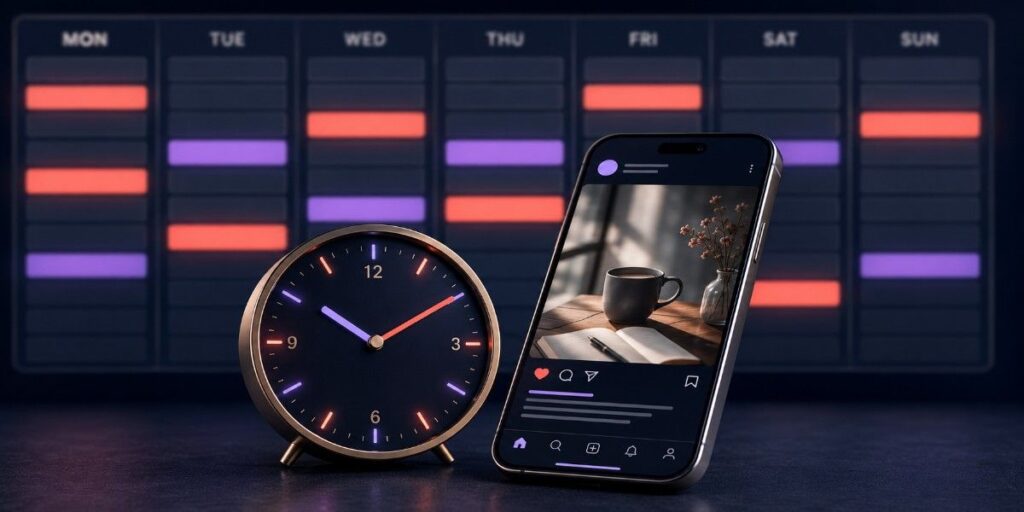
The best day to post on Instagram depends on what the content needs from the audience. A light meme, a detailed carousel and a product launch should not carry the same timing rule.
Use this day logic:
1) Put important carousels on strong weekday slots.
2) Place Reels when the audience has viewing time.
3) Keep event reminders close to the actual date.
4) Test weekend posts for lifestyle, travel and food pages.
5) Avoid launching heavy posts during known audience downtime.
Business accounts should also watch customer behaviour outside Instagram. Restaurant pages may benefit before meal decisions. Fitness pages may see interest before morning or evening workouts. Education pages may perform better when students are planning study time.
Build a 14-Day Posting Test
A proper Instagram posting schedule needs a clean test window. Posting randomly and judging the result by likes alone creates weak data.
Use this two-week plan:
1) Pick three time blocks from Insights and public benchmarks.
2) Publish similar content formats in each block.
3) Keep captions, topic depth and creative quality comparable.
4) Record reach, saves, shares, comments and profile actions.
5) Remove posts affected by giveaways, ads or collaborations.
6) Keep the strongest two slots for the next month.
This method makes the best time to post on Instagram easier to defend. It also helps teams avoid arguments based on one viral post.
What to Do If You Need to Publish Today?
When no history is available, the best time to post on Instagram today should be chosen from audience routine rather than panic. Pick a slot when followers can notice the content and respond within the first hour.
Use these quick choices:
- Post before work for motivation, fitness or news updates.
- Post around lunch for educational carousels or explainers.
- Post early evening for Reels, lifestyle and entertainment.
- Post later evening only when followers regularly stay active.
- Avoid posting right before a meeting, travel rush or event clash.
If the post is important, support it with Stories after publishing. Use a poll, question sticker or teaser to direct interested followers toward the post without repeating the same message.
Metrics That Decide the Real Posting Window
The best time to post on Instagram should be judged by useful actions, not surface numbers alone. Likes can help, but they do not always prove that the timing worked.
| Metric | What it suggests | Use for timing decisions |
| Reach | Fresh audience discovery | Compare first-hour and full-day reach |
| Saves | Reference value | Useful for education, travel and finance posts |
| Shares | Audience willingness to spread content | Strong for Reels and relatable posts |
| Comments | Conversation quality | Useful for community-led pages |
| Profile actions | Business intent | Important for brands and service pages |
| Watch time | Reel strength | Compare by posting window |
A good slot should improve the action that the post was built for. A carousel made for saves should not be judged like a Reel made for shares.
Also read: Things to Do in Delhi for History, Street Food and Local Culture
Final Timing Answer
The best time to post on Instagram is the slot where your audience is active, your content format has room to perform and your last few results show stronger actions. Public studies can supply starting points, but account Insights must guide the final decision. Test three windows, separate Reels from carousels, review useful metrics and keep updating the calendar monthly. A steady testing system beats a copied hour because Instagram audiences rarely behave the same across niches, countries and content formats.
FAQs
Does posting time affect Instagram reach immediately?
Posting time can affect early reach because active followers may see and interact with content sooner. Early saves, shares, comments and watch time can help performance, although creative quality and audience match remain stronger long-term factors.
Should small accounts follow public timing studies?
Small accounts can use public timing studies as starting points, mainly when Insights data is limited. After a few weeks, their own follower activity and post results should guide the publishing calendar.
Do carousels and Reels need different posting times?
Carousels often need audience attention for reading and saving, while Reels need viewing time and replay potential. Testing them in separate windows gives cleaner data than mixing every format into one slot.
How long should an Instagram timing test run?
Ideally your timing test should run for two weeks or longer with consistent formats across your selected time blocks. Big accounts may hit their sample data faster but smaller pages may need up to a month of testing.
Can posting too often reduce performance?
Posting too frequently can actually hurt your performance when content quality decreases or followers begin to turn off from your feed. A strategic flow of quality posts with defined formats and tested time slots will perform better than spamming your calendar with whatever you felt like uploading that day.





Leave a Reply